

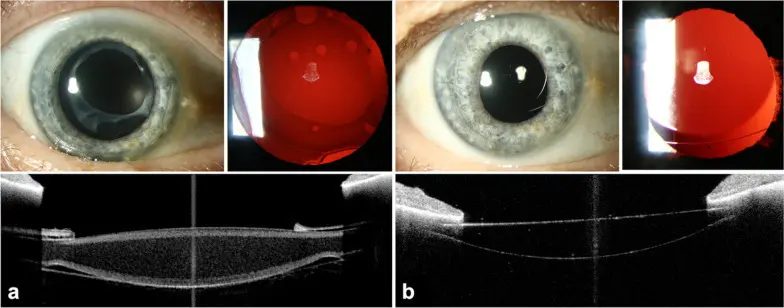
In current practice, we find there is a lack of functional and patient-reported data about those patients undergoing IOL exchange surgery when their primary lens has undergone a material change, such as calcification. Our colleague Timur Yildirim and his co-authors from The David J Apple Center for Vision Research set out to evaluate subjective and objective outcomes following IOL exchange due to homogeneous IOL calcification; they aimed to improve evidence‐based patient counselling.
The problem:
Homogeneous calcification of an intraocular lens (IOL) significantly undermines a patient’s visual quality. Unfortunately, there is a notable gap in functional and patient-reported data concerning individuals who undergo IOL exchange surgery due to this material change. This study evaluated subjective and objective outcomes following IOL exchange for homogeneous IOL calcification, ultimately the goal is to enhance evidence-based patient counselling.
The approach
Dr Yildirim reported, we conducted a prospective, non-interventional clinical study; 53 eyes of 42 patients with homogeneous IOL calcification were included. An IOL exchange was performed in 30 of these eyes. We rigorously assessed subjective symptoms using the Catquest-9SF quality-of-life questionnaire, along with photic phenomena, corrected distance visual acuity (CDVA), straylight (using the C-Quant device from Oculus, Wezlar, Germany), and contrast sensitivity both with and without glare (measured with VectorVision, Houston, USA) before the surgery (T0) and at 3 to 12 months post-surgery (T1).
The results.
These were compelling: preoperative CDVA and straylight did not correlate. We saw a significant reduction in the average size and intensity of halo and glare, alongside notable improvements in the Catquest-9SF scores. The CDVA increased significantly from 0.16 ± 0.13 to 0.05 ± 0.10 logMAR, and contrast sensitivity showed marked enhancement both with and without glare. Moreover, the straylight values exhibited a statistically and clinically significant decrease from 2.32 ± 0.34 to 1.23 ± 0.33 log(s).
The conclusion: Homogeneous IOL calcification does not always correlate with a severe reduction in visual acuity. However, IOL exchange consistently alleviates subjective complaints and markedly enhances the quality of vision for affected patients. Importantly, visual acuity cannot be the only functional parameter in assessing patients with homogeneous IOL calcification; intraocular straylight and contrast sensitivity provide a more accurate reflection of visual impairment.
Dr. Yildirim strongly recommends using a straylight value above 1.56 log(s) as a critical threshold for determining the necessity of IOL exchange surgery.
Please check out their paper, funded by the European Society of Cataract and Refractive Surgeons (ESCRS) Pioneer Research Award.
Yildirim TM, Łabuz G, Henningsen N, Son HS, Augustin VA, Britz L, Chychko L, Khoramnia R, Auffarth GU. Establishing an objective decision criterion for intraocular lens exchange due to homogeneous calcification: a prospective clinical analysis. Eye Vis (Lond). 2024 Dec 2;11(1):46. doi: 10.1186/s40662-024-00415-z. PMID: 39617931; PMCID: PMC11610101.
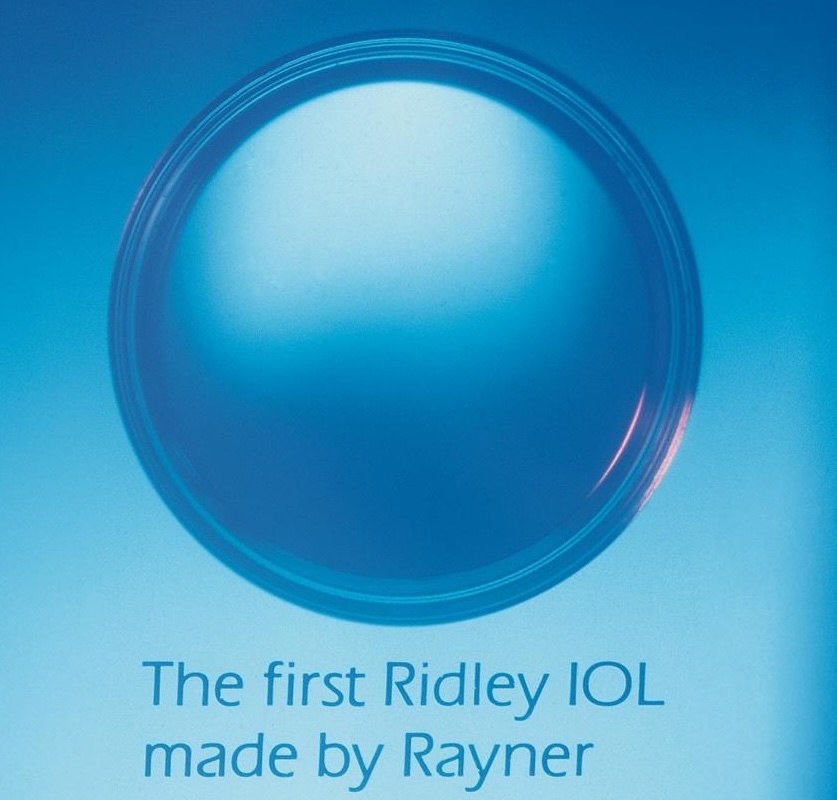 How was the Ridley-Rayner IOL made?