

The background
Phakic intraocular lenses (pIOLs) have been introduced for presbyopia correction, yet there are no studies to date directly comparing the various models to one another.
What we did
At the David J Apple Laboratory, we assessed and compared the optical quality of two phakic IOLs - a diffractive IPCL (Care Group) with +2.5D added power and the newly launched refractive Artiplus (Ophtec) using a custom-made insert (to mimic the presbyopic eye) containing a −3D phakic IOL and a 23D monofocal (Precizon Monofocal, Ophtec).
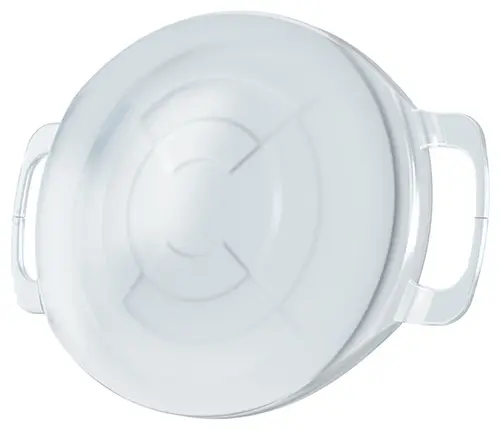
The Artiplus (Image from Ophtec bv.)
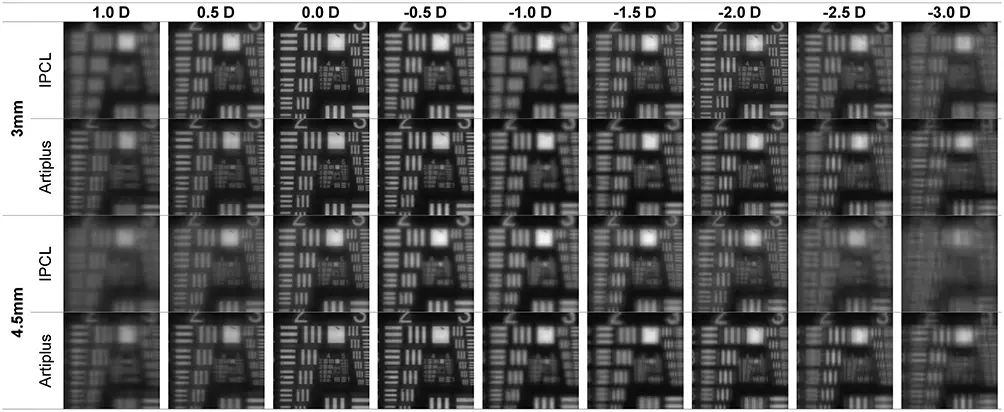
Two -3D samples of each pIOL were tested using our OptiSpheric IOL PRO2 under spherical and chromatic-aberration conditions at 3 and 4.5mm apertures at near (40cm), intermediate (67cm) and far distances. Modulation transfer function (MTF) related variables, and the 1951 USAF resolution target images were compared.
Our Results
The MTFs at far distances, 67cm, and 40cm revealed minor differences between the two IOLs for a 3-mm pupil. Simulated visual acuity showed no disparity at distance but improved by 0.01 and 0.05 logMAR with Artiplus at intermediate and near points.
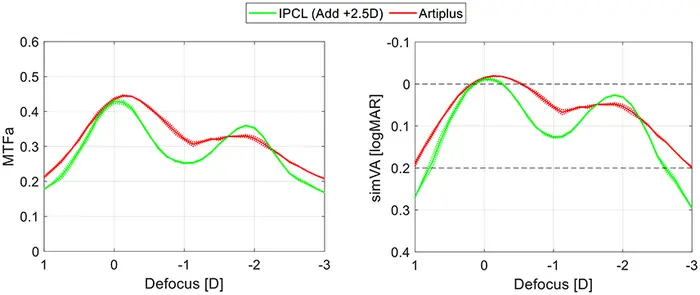
The area under MTF curve and simulated VA of the tested lenses at 3mm aperture. The MTFa and simVA are graphed as a function of spectacle defocus. The dotted lines show the values of each lens separately; the solid lines refer to the average of two lenses.
Additionally, Artiplus exhibited a plateau in intermediate performance, while the IPCL demonstrated higher optical quality close to 50cm, corresponding to its secondary-focus location. Both lenses showed reduced optical quality with larger apertures. The USAF resolution target results supported these findings.
Our conclusions
Both the Artiplus and IPCL (+2.5D add) showed good optical quality across the focus range, with Artiplus having a flatter simulated defocus curve. While the differences were minimal in expected visual acuity, in a clinical setting these differences may become more pronounced in patients with larger pupils. We look forward to comparing our results with future clinical results.
Please read our paper at
https://doi.org/10.2147/OPTH.S539090
Zielinska A, Niknahad A, Labuz G, Wu Z, Son HS, Auffarth GU, Khoramnia R. Objective Evaluation and Comparison of Diffractive versus Refractive Phakic Intraocular Lenses for Presbyopia Correction. Clin Ophthalmol. 2025;19:3783-3792
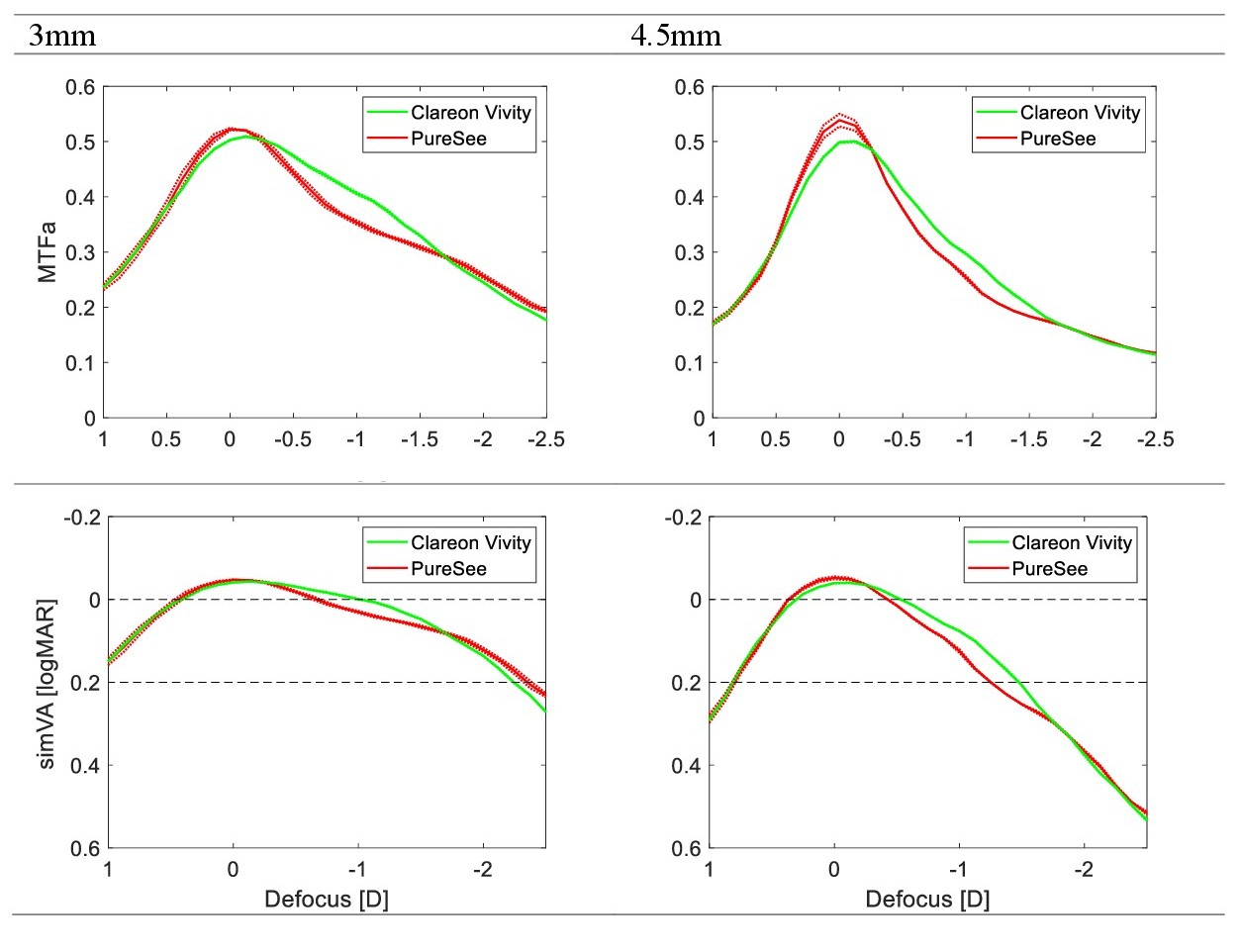 Vivity and PureSee