

Happy Christmas from the Apple Lab!
Heidelberg, 22 December 2025. We are very pleased that our paper on refining monovision has been published (Open Access) in the most recent edition of the esteemed journal Graefe’s Archive for Clinical and Experimental Ophthalmology.
Refining mini-monovision with monofocal plus intraocular lenses. Tadas Naujokaitis,· Gerd U. Auffarth, Zhiyi Wu, Fátima Cuéllar, Ramin Khoramnia, Grzegorz Łabuz. Graefes Arch Clin Exp Ophthalmol (2025).
The background
Mini-monovision is used to increase spectacle independence after cataract surgery by targeting emmetropia in one eye and mild myopia in the fellow eye. Enhanced monofocal (“monofocal plus”) IOLs can improve intermediate and near vision while maintaining good distance quality vision. Still, comparative data across different IOL models in a mini-monovision setting are limited, so we set out to compare the RayOne EMV (Rayner), marketed for mini-monovision, with the Acunex Quantum (Teleon Surgical), an enhanced monofocal lens primarily designed for improved intermediate vision.
What we did
At the David J. Apple Laboratory, we evaluated and compared the optical performance of the RayOne EMV and Acunex Quantum in simulated mini-monovision. Using the OptiSpheric IOL PRO2, we tested two samples of each IOL at 10D, 20D, and 30D powers under polychromatic light and a model cornea with positive spherical aberration, with 3-mm and 4.5-mm apertures to represent photopic and mesopic conditions.
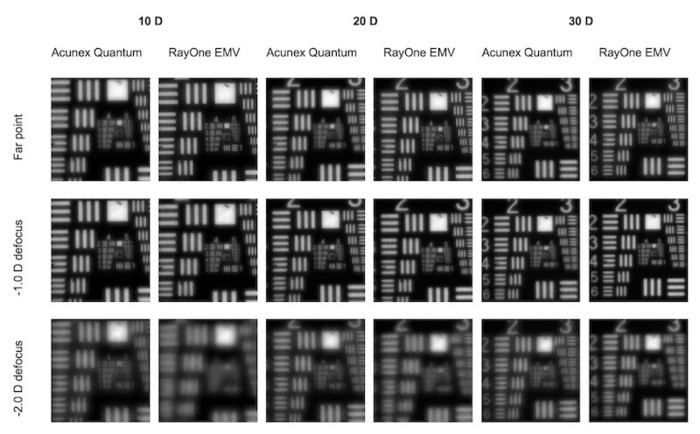
The figure shows binocular USAF-resolution targets recorded at 0 D, −1.0 D, and − 2.0 D of defocus, created using the quadratic summation of two images with the myopic offset of −1D
We measured modulation transfer function (MTF) and phase transfer function (PTF) from +0.50D to −2.50D spectacle-plane defocus and recorded USAF 1951 resolution targets through each lens. From the optical data, we derived simulated visual acuity (simVA) defocus curves. Mini-monovision was then simulated by shifting defocus curves for myopic offsets from −0.25D to −1.0D and applying a binocular summation model; quadratic summation of USAF images was used to visualize binocular impressions.
What we found
For bilateral plano implantation, both IOLs showed very similar simulated distance acuity, but Acunex Quantum provided a more extended depth of focus, particularly at 10D and 20D. This advantage decreased at 30D. USAF images confirmed better resolution for Acunex Quantum at negative defocus levels, while RayOne EMV was slightly superior at low positive defocus.
In simulated mini-monovision, low offsets (−0.25D, −0.50D) slightly broadened the binocular depth of focus with minimal loss of distance simVA. A −1.0D offset yielded the greatest depth of focus, with simVA of 0.1 logMAR or better out to about −2.0D to −2.4D for Acunex Quantum and −1.8D to −2.1D for RayOne EMV, at the cost of a small decrease in binocular distance vision. RayOne EMV showed somewhat better distance quality in the myopic eye at lower IOL powers.
Our conclusions
Both Acunex Quantum and RayOne EMV are suitable for mini-monovision. Acunex Quantum offers greater depth of focus, while RayOne EMV provides slightly better low-defocus tolerance, particularly with lower IOL powers. The differences diminish with increasing power, and clinical studies will be needed to confirm how these optical findings translate into patient outcomes.
To read our paper
Here is the link to our paper (open-access): https://rdcu.be/eV4kW
 Artiplus and IPCL