

Heidelberg. 15 August 2024. Intraocular lens (IOL) injectors have revolutionized cataract and refractive surgery by allowing smaller incisions, reducing postoperative complications such as astigmatism, aqueous leakage, and endothelial cell loss. Since the 1980s, the technology has evolved from forceps techniques to sophisticated injector systems. Early, multi-piece, reusable injectors have given way to single-use modern devices designed for improved precision and safety.
Our Review.
We just published (in English) a review in a German journal, Klinische Monatsblätter für Augenheilkunde, our laboratory research, focusing on injector models available in Europe and North America and we provide an overview of the defining characteristics and advances in IOL injectors. We also highlight the need for ongoing innovation in IOL injector technology to maintain the benefits of small incisions and reduce surgical complications.
These modern IOL injectors vary in loading mechanisms (manual vs preloaded), implantation mechanisms (push-type, screw-type, automated), and tip designs. Preloaded injectors, such as the iTec by Johnson & Johnson Vision, offer time efficiency and reduce the risk of IOL damage during surgery. Automated injectors, like the Alcon AutonoMe, allow for single-handed, consistent implantation with minimal incision enlargement.
Our Findings
Despite all the advances, complications still occur, such as IOL misconfigurations and injector damage. Common issues include IOL adherence to the plunger, trapped haptics, and rotational misconfigurations (Figure 1).
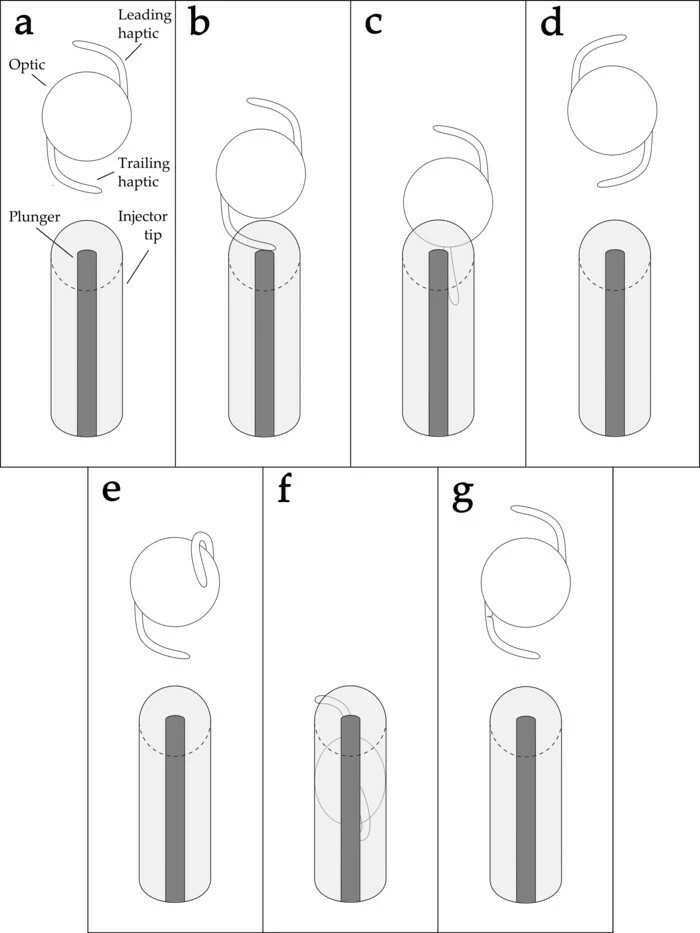
*Figure 1. Overview of common intraocular lens (IOL) misconfigurations during IOL implantation with an injector. (a) Normal IOL implantation without misconfiguration; (b) Adherence of the IOL to the plunger tip; (c) Trapped haptic of the IOL in the injector tip; (d) Upside-down configuration of the IOL; (e) Haptic-optic adhesion; (f) Overriding plunger in the injector tip; (g) Defect at the optic-haptic junction of the IOL.*
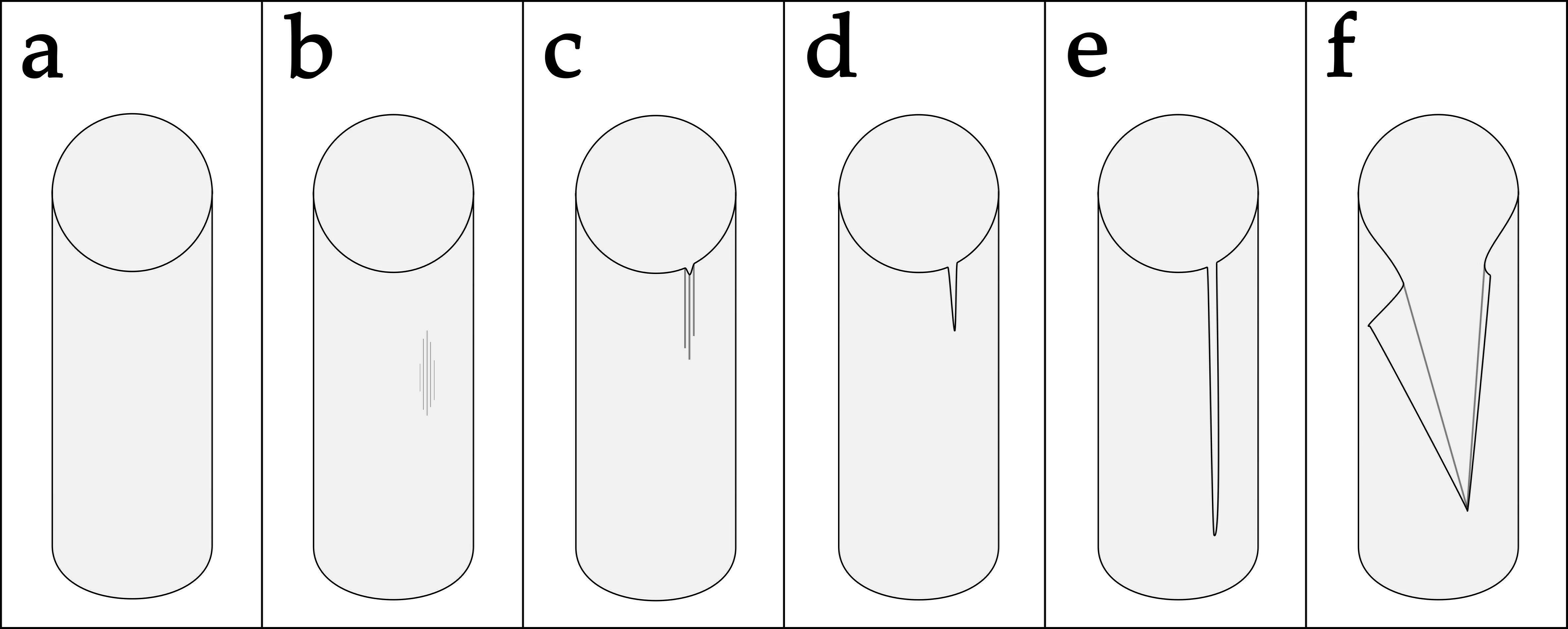
Damage to the injector varies in severity and the level of damage can be classified using the HeiScore (Figure 2).
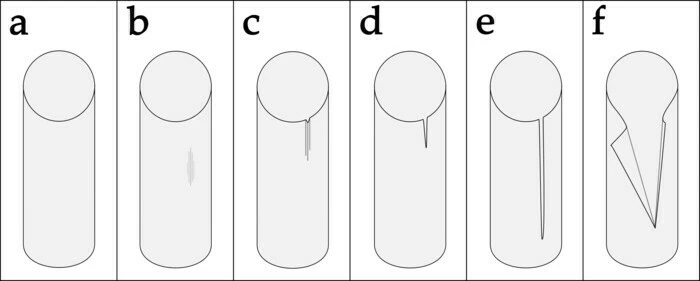
Figure 2. Visualization of the Heidelberg score for IOL injector damage (HeiScore) (a) No damage in the injector tip; (b) Slight scratch with fine stress lines on the inner tube; (c) Deep scratch with deep stress lines and/or discontinuity of the injector tip; (d) Extension of a deep stress line, but not in the total thickness; (e) Full-thickness crack of the injector tip; (f) Burst of the injector tip.
The Future
Our research continues to address these challenges and improve injector designs to ensure safer, more predictable surgeries.
For more detailed information, please refer to our comprehensive study on the characteristics and complications associated with IOL injectors,
Friedrich M, Munro DJ, Auffarth GU, Khoramnia R. Characterisation of Intraocular Lens Injectors. Klin Monbl Augenheilkd. 2024 Aug;241(8):905-916. English. doi: 10.1055/a-2349-2158. Epub 2024 Aug 15. PMID: 39146575.
 CAIRS
CAIRS