

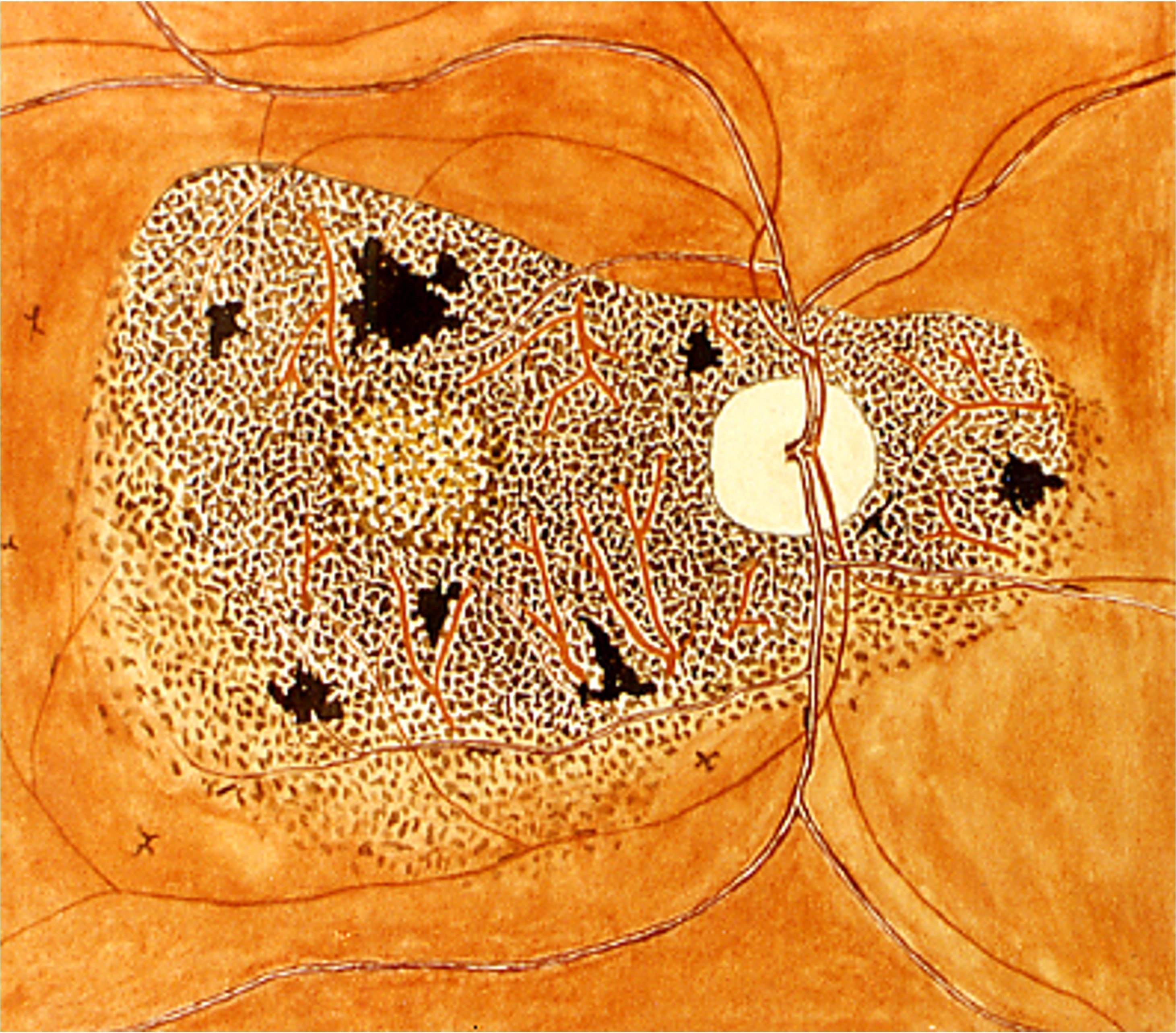
Happy New Year from Heidelberg.
Thank you for reading the news and posts from the D J Apple Lab through 2025. We hope we were able to provide you with the information and context you needed to stay up to date on the latest news about ophthalmic research at our centre.
Elsewhere, in the wider media in 2025, the news was dominated by war and disaster, so much so that it can make one fearful of what will happen in the coming year. But let’s keep in mind that there was good news in 2025 and we can build on it in 2026. We were especially pleased to learn of success in the treatment of one disease, onchocerciasis (river blindness).
Much of our work is lab research on intraocular lenses (IOLs). The IOL was invented by Sir Harold Ridley, and the first IOL was made in 1949. Some years earlier, Ridley had studied patients with river blindness in northern Ghana. We are sure that Ridley would be delighted by the news that, in early 2025, the World Health Organization (WHO) officially recognized the Republic of Niger, a landlocked state in West Africa, as the first African country and the fifth globally to eliminate onchocerciasis (river blindness). Niger is one of the poorest countries in the world, according to the UN, so this is a significant national achievement, combined with an international effort to fight infectious diseases.
Onchocerciasis is a parasitic disease transmitted through the bites of infected black flies, which are endemic around rivers in tropical countries. It is the second leading infectious cause of blindness globally. It primarily affects rural populations in sub-Saharan Africa, Yemen, and parts of Latin America. In Niger, the disease has been prevalent in the land near the Niger River. The WHO reported that Niger’s success was made possible through a combination of:
- Vector control (black fly population reduction) through insecticide spraying from 1976 to 1989, under the WHO Onchocerciasis Control Programme.
- Mass drug administration campaigns using ivermectin and albendazole from 2008 to 2019, targeting both onchocerciasis and lymphatic filariasis.
- Rigorous epidemiological and entomological surveillance confirming transmission interruption, with onchocerciasis prevalence dropping from 60% to 0.02%.
- Strong partnerships between the Niger government, WHO, Merck (MSD), and other international health organizations, ensure sustained technical and financial support.
Niger is the fifth country where WHO has verified elimination of onchocerciasis. The other countries are:
• Colombia (eradication verified in 2013)
• Ecuador (verified in 2014)
• Mexico (verified in 2015)
• Guatemala (verified in 2016)
But these countries are in Central and South America - Niger is the first African country to eliminate river blindness. Also, this is Niger’s second elimination of a neglected tropical disease. In 2013, Niger was declared free of Guinea-worm disease. The achievement sets a target for other African nations that are still battling river blindness.
“Niger’s success in eliminating onchocerciasis has had profound social and economic impact, from patients saving on out-of-pocket health expenses and being able to lead more productive lives, to families of those affected no longer being responsible for caretaking and able to pursue education and job opportunities,” says Dr Amadou Salissou, National Coordinator of Niger’s Onchocerciasis and Lymphatic Filariasis Programme, who has led the fight against river blindness in Niger for more than 20 years. “Niger’s leadership and journey to eliminating this disease provide a powerful story of resilience, innovation, and collaboration, a successful model for other countries striving for similar victories.”
Prof. Dr. med. Gerd Auffarth drew on his own memories of tropical medicine when, in the 1990s, he worked as a young surgeon in Gabon, at the Albert Schweitzer Hospital in Lambaréné.
“What has been done in Niger shows what can happen when countries and international agencies unite around a single goal: eradicating a disease. Surely this can be repeated throughout West Africa. I congratulate Dr Salissou and colleagues for what they have done. There is now hope for other countries where onchocerciasis is endemic, including Gabon, where I worked, and Ghana, where Ridley wrote his monograph on the disease. It was stated to have been eliminated in Ghana, but the WHO clearly considers Niger the first. Until it is eliminated from the whole continent, there will be the threat of reintroduction from neighbouring countries. But this is good news for Niger and an important milestone on the road to elimination across the continent.”
Happy New Year!
Further reading
- https://www.who.foundation/post/nigers-defeat-of-river-blindness
- https://www.telegraph.co.uk/global-health/science-and-disease/nigers-historic-triumph-over-river-blindness-is-a-beacon-of/
- Auffarth GU, Schmidbauer J, Apple DJ. Zum Lebenswerk von Sir Nicholas Harold Lloyd Ridley [The life work of Sir Nicholas Harold Lloyd Ridley]. Ophthalmologe. 2001 Nov;98(11):1012-6. German. doi: 10.1007/s003470170019. PMID: 11729731.
 Refining mini-monovision