
Heidelberg 11 July 2024. I am very pleased to report some of the details of a recent case of Immediate Simultaneous Bilateral CAIRS (Corneal Allogeneic Intrastromal Ring Segments) surgery (ISBCS).
A 35-year old male presented to our keratoconus clinic complaining of bilateral reduced vision, despite spectacle correction due to significant astigmatism. His occupation as a welder with heavy exposure to a dusty environment made him an unsuitable candidate for contact lenses.
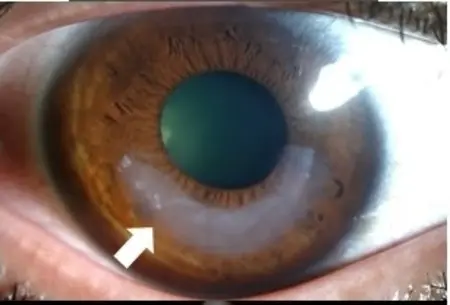
The patient’s right eye before and one week after the operation:
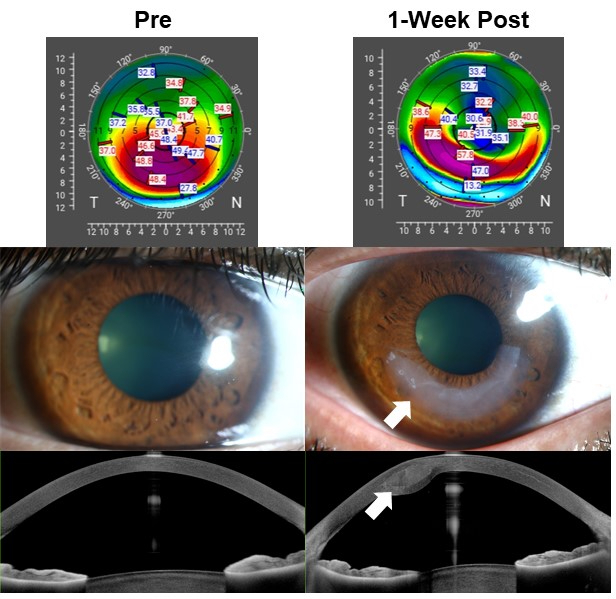
Then, the left eye, before and one week after surgery:
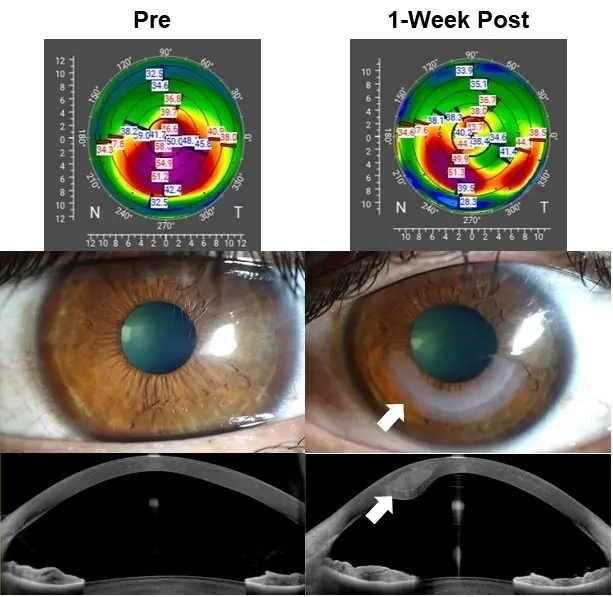
The patient’s uncorrected distance visual acuity (UDVA) values were 0.2 decimal in his right eye (OD) and 0.08 in the left (OS). His corrected distance visual acuity (CDVA) was +0.5 -8.0 77° = 0.63 OD and +2.0 -10.0 108° = 0.25 OS.
Corneal tomography demonstrated significant corneal ectasia in both eyes with paracentral steepening. We recommended the CAIRS procedure as an attempt to regularize the corneal curvature and improve vision. After detailed consultation with the patient, we agreed upon bilateral implantation of KeraNatural ring segments and with my assistance, Professor Auffarth performed the operations on both eyes on the same day.
At 1-day postoperatively, the UDVA already improved to 0.4 OD and 0.25 OS, which further increased to UDVA 0.5 OD and 0.63 OS at 1-week postoperatively!
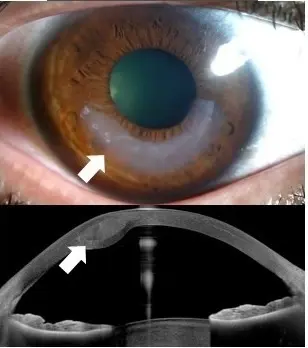
The white arrow indicates the position of the intrastromal ring in a photo of the right eye and its appaerance in a cross-sectional image of the same eye.
These results demonstrate that the CAIRS can be performed in an effective and safe manner bilaterally on the same day and provide an alternative to keratoplasty for visual improvement in keratoconus patients. We continue to monitor the patient’s progress but the prognosis looks very good.
Prof. Auffarth commented on the case, “This is our first case, at University Hospital Heidelberg, of Immediate Simultaneous Bilateral surgery with CAIRS. This implant is an Allogeneic graft ring segment provided by VisionGift and we are grateful to them for the quality of the product and the prompt service they provided. We are excited about the results. The CAIRS technique was first developed by Dr Soosan Jacob from Chennai, India, and we are still learing about it. It will be our honor to welcome Dr Jacob as our keynote speaker on November 23rd at our Helmholztage Symposium in Heidelberg.”
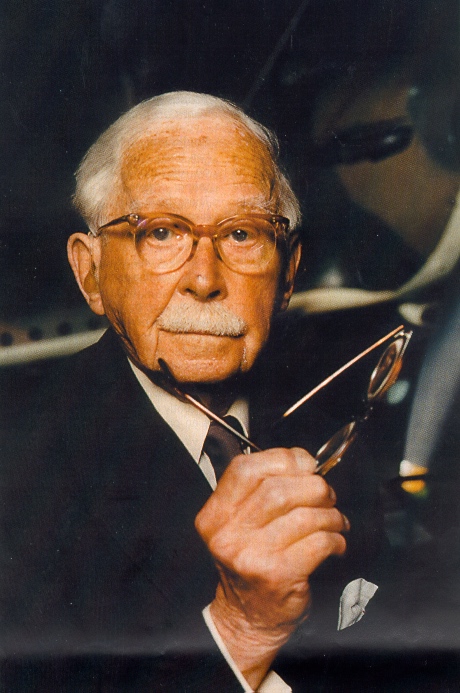 Harold Ridley's birthday, 10 July