
Heidelberg 24 July 2025. We are excited to announce our latest comparative study, published this month in Nature Scientific Reports, which delves into examining two leading models of Extended Depth of Focus (EDoF) intraocular lenses: the Clareon Vivity and the Tecnis PureSee.
- Niknahad, A., Wu, Z., Son, HS. et al. Evaluation of Clareon Vivity and PureSee intraocular lenses: optical quality, depth of focus and misalignment effects. Sci Rep 15, 26943 (2025).
Why is EDoF important?
The average daily screen time is around 7.2 hours, with a global average of 6.7 hours per day. We typically have a viewing distance of 54 cm to 62 cm when looking at a computer. In comparison, those of us who are not presbyopic look at their smartphones at an average 35 cm distance, and presbyopes at 39 cm. However, it is not just screen-viewing; other activities, such as shopping, conversing, dining, and controlling the car dashboard, all depend on proper visual acuity (VA) at distances between 50 cm and 100 cm, which we refer to as intermediate vision. Given the reliance on intermediate vision in daily life, it has become crucial for individuals undergoing cataract surgery or refractive lens exchange to expect to get IOLs that allow spectacle-free vision at these distances. EDoF IOLs significantly enhance intermediate-distance vision.
Our approach.
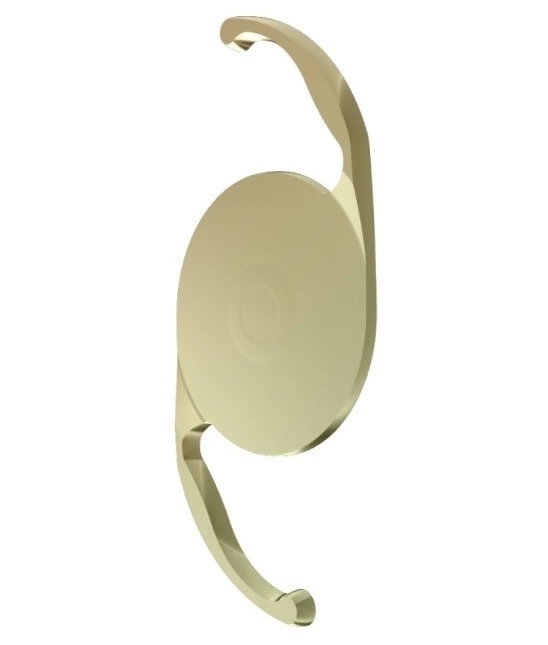
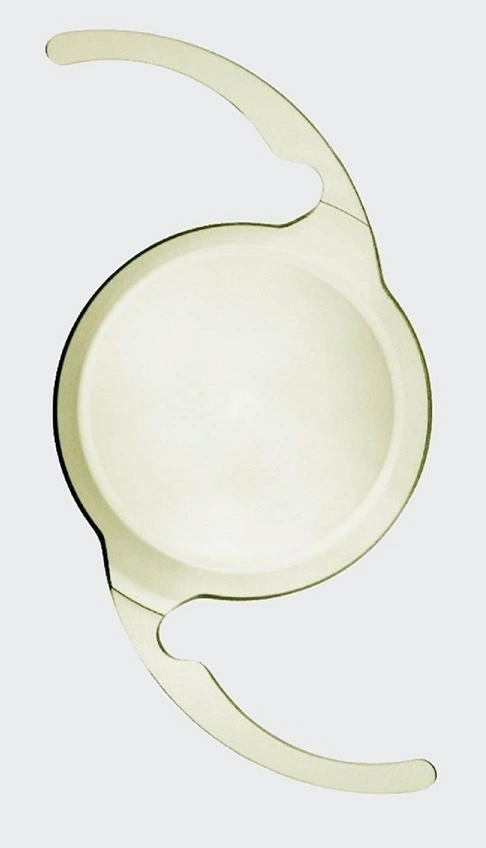
Alcon Clareon Vivity
We rigorously evaluated the optical quality of the Alcon Clareon Vivity and Johnson & Johnson’s Tecnis PureSee using our lab’s metrology device. The two materials, Clareon and Tecnis, are chemically different and possess unique chemical and physical properties. Each lens model features its own distinct optical design that can with the material have an impact on visual outcomes.
Johnson & Johnson’s Tecnis PureSee™
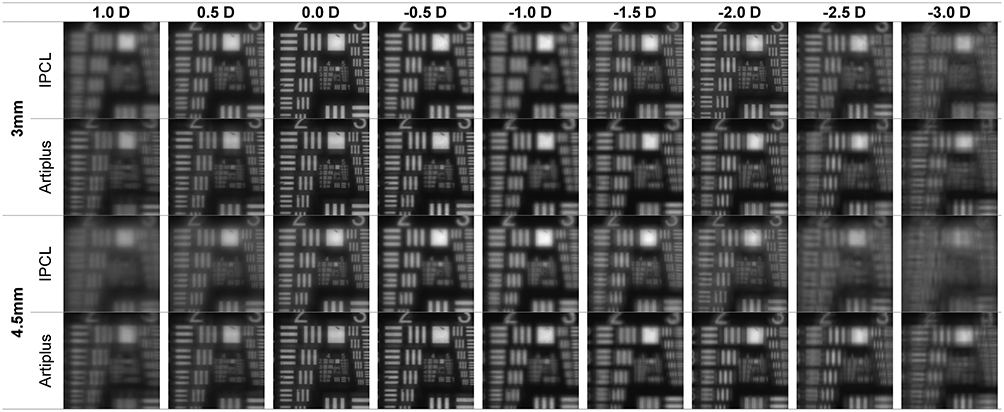
We measured Modulation Transfer Function (MTF) in conjunction with recording the 1951 USAF resolution test chart at both 3.0-mm and 4.5-mm apertures. We also systematically measured the lenses’ tolerance to 0.50 mm decentration and a 5° tilt, while analysing potential unwanted visual effects through their light distribution at a 4.5 mm aperture, specifically beyond a polychromatic point spread function centre.
What did we find?
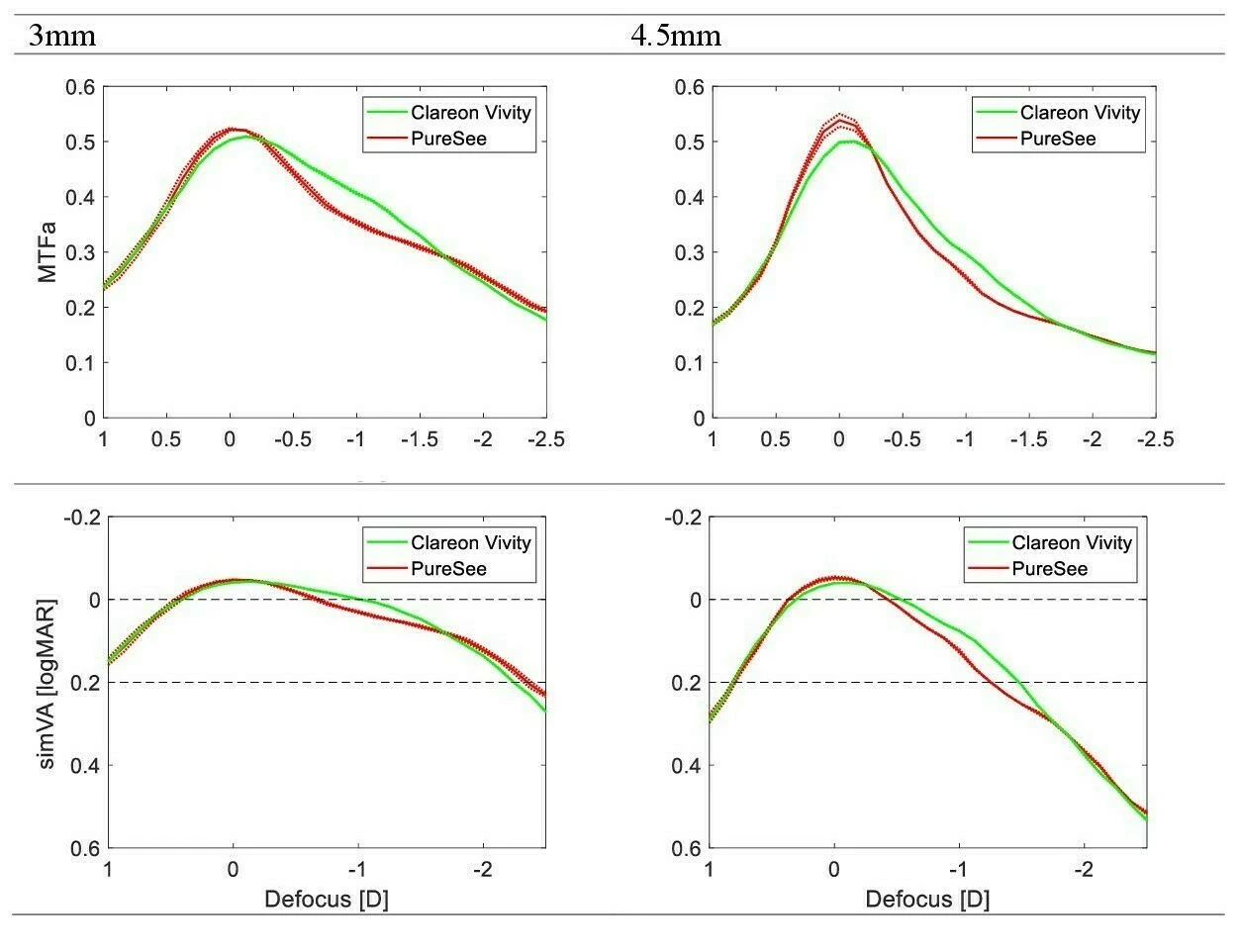
Our findings reveal that both lens models deliver alike optical quality for intermediate and far vision. The predicted visual acuities for the Vivity and PureSee measured respectively −0.04 logMAR versus −0.05 logMAR at 0 diopters and 0.05 versus 0.07 logMAR at −1.50 diopters of defocus. Importantly, we observed that increasing the pupil size diminished the optical quality for both lenses. While decentration did affect optical quality, the impact of lens tilting was minimal. Both were similar in introducing few unwanted side effects through visualizing a halo pattern.
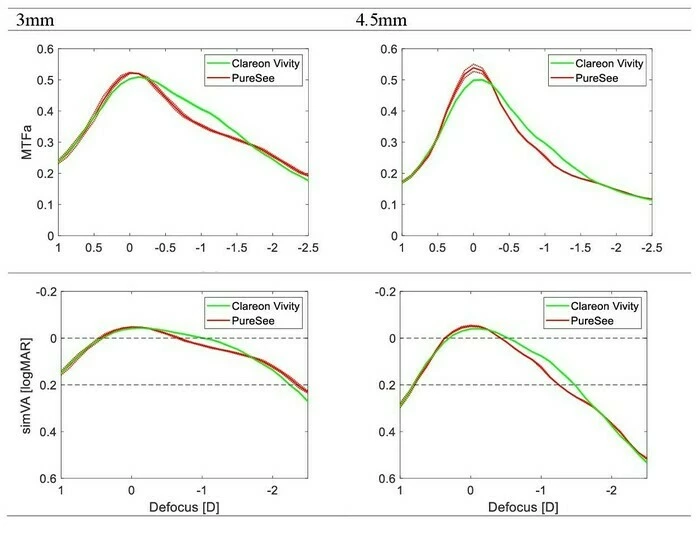
Charts of simulated Visual Acuity (simVA) for the two lens models.
The conclusion.
These compelling results suggest that the Clareon Vivity and Tecnis PureSee are both excellent options for patients considering EDoF lenses. As we move forward, future clinical studies will provide deeper insights into their long-term performance and any side effects they may have, paving the way for improved patient outcomes in vision correction.
Read more …
To download the full paper, here is the link
 Safety in IOL exchange