

Heidelberg, 25 November 2024. As we approach the 75th anniversary date of the IOL, 29th November, we continue to learn more about Sir Harold Ridley’s achievements besides his invention and implantation of the first intraocular lens.
Radio Broadcast on River Blindness
In a previous article, we read Ridley’s description of River Blindness and how he travelled to Funsi in northern Ghana (then known as the British Gold Coast) to find patients with the disease. On his return to the capital, Accra, Ridley was interviewed at a local Radio Station, ZOY Gold Coast. We do not know if this was recorded and if a recording is extant; still, we do have an account that was put out by the Department of Information in Accra and published on 7th June 1944 in their newsletter, The Empire at War, No. 244. (Either news had not reached Accra about the Allied landings the day before in Normandy, or news of D-Day was still classified as Top Secret.)
(Note: The Empire at War was a weekly newsletter put out by the colonial government Department of Information in Accra. Publication began in September 1939 and ceased in December 1945. The paper was Harold Ridley’s own copy which he gave to David Apple in the 1990s.)
Here is the front page report:
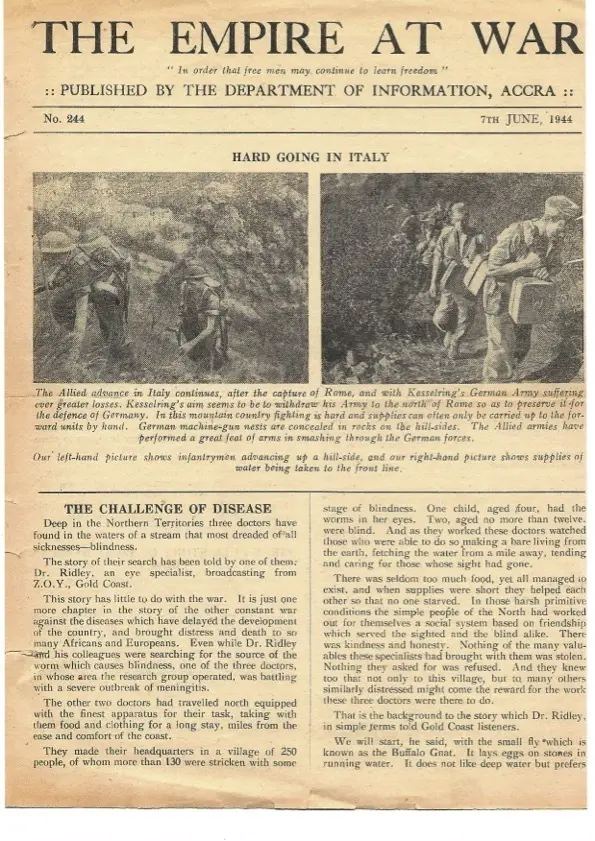
Deep in the Northern Territories three doctors have found in the waters of a stream that most dreaded of all sicknesses - blindness.
The story of their search has been told by one of them: Dr. Ridley, an eye specialist, broadcasting from Z.O.Y., Gold Coast.
This story has little to do with the war. It is just one more chapter in the story of the other constant war against the diseases which have delayed the development of the country, and brought distress and death to so many Africans and Europeans. Even while Dr. Ridley and his colleagues were searching for the source of the worm which causes blindness, one of the three doctors, in whose area the research group operated, was battling with a severe outbreak of meningitis.
The other two doctors had travelled north equipped with the finest apparatus for their task, taking with them food and clothing for a long stay, miles from the ease and comfort of the coast.
They made their headquarters in a village of 250 people, of whom more than 130 were stricken with some stage of blindness. One child, aged four, had the worms in her eyes. Two, aged no more than twelve were blind. And as they worked these doctors watched those who were able to do so making a bare living from the earth, fetching the water from a mile away, tending and caring for those whose sight had gone. There was seldom too much food, yet all managed to exist, and when supplies were short they helped each other so that no-one starved. In those harsh, primitive
conditions the simple people of the North had worked out for themselves a social system based on friendship which served the sighted and the blind alike. There was kindness and honesty. Nothing of the many valuables these specialists had brought with them was stolen. Nothing they asked for was refused. And they knew too that not only to this village, but to many others similarly distressed might come the reward for the work these three doctors were there to do.
That is the background to the story which Dr. Ridley. in simple terms told Gold Coast listeners.
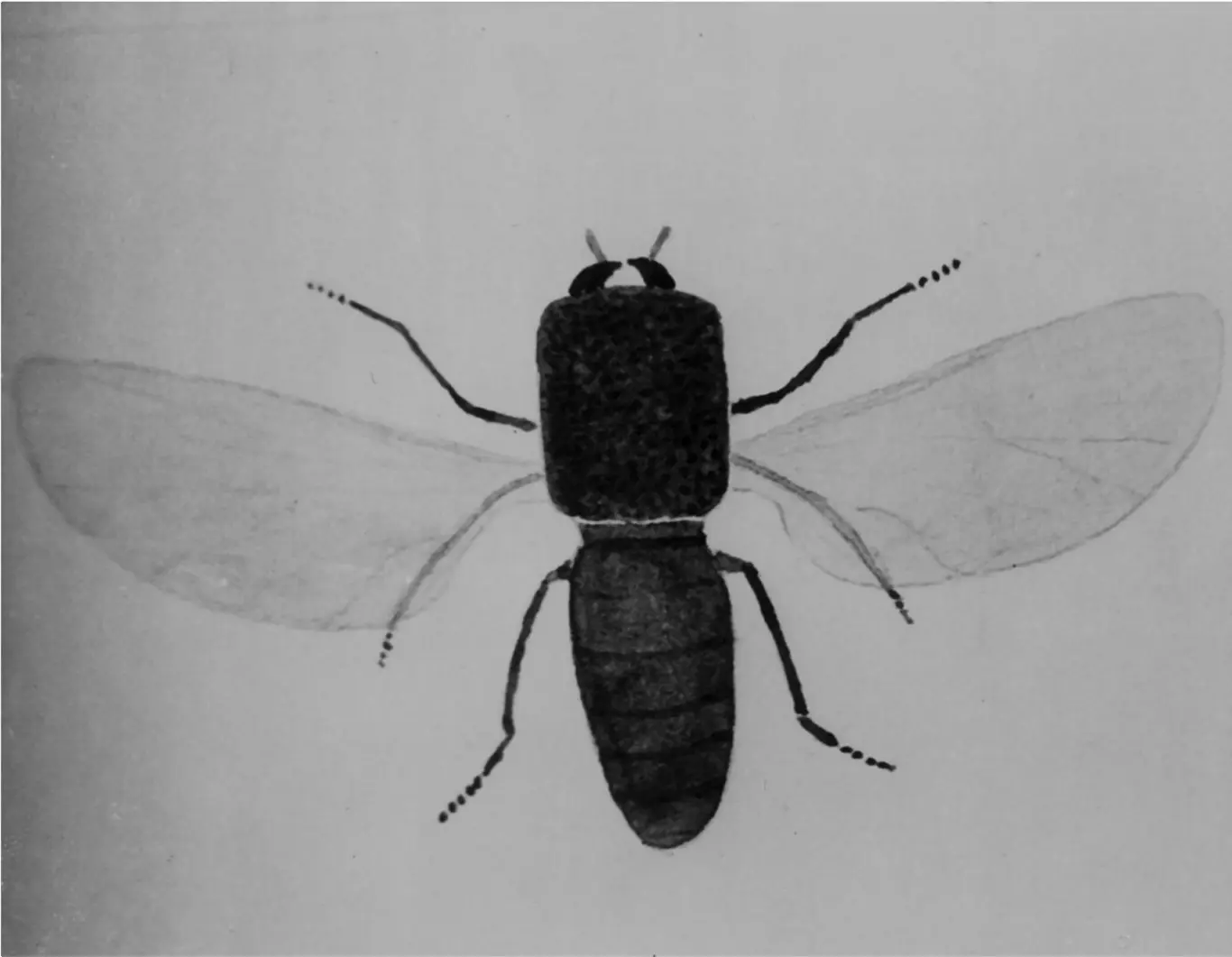
We will start, he said, with the small fly which is known as the Buffalo Gnat. It lays eggs on stones in running water. It does not like deep water but prefers r streams where water runs over the stones making little ripples where it does so and bubbling up as it falls from stone to stone. The eggs are laid on the stones and in due course they hatch out and the fly takes to the long grass by the side of the stream. It is a lazy fly and therefore does not wander from its hiding place. But if a man or an animal touches the grass, the fly will come out and bite him. Its bite is very painful. Cases have been reported where herds of domestic animals have been so maddened that they rushed into a river and drowned. The fly by itself is quite harmless but if it bites a man or beast who has got the disease the fly will take in the small worms to its own body and then it can give them to any other man or beast that it bites. These worms, so small that they cannot be seen with the naked eye, then begin to grow inside until they are two or three inches long. Their presence forms rubber-like lumps beneath the skin - and it is here that the worms lay their eggs. It must not be thought that everyone in the Gold Coast who has lumps in the skin is harbouring the Blinding Worm. It is only in the districts where Buffalo Gnat abounds that these skin lumps are likely to be due to Blinding Worms. From these lumps the young worms are hatched. They are very very small worms and they cause blindness. They bore their way into the eye and although they may do little harm when alive, when they are dead they poison the eye and this leads to blindness. The process is generally very slow and almost free from pain. Generally it takes some ten years to make the eye quite blind and the patient does not notice the very slight deterioration that goes on all the time.
It is not easy to control this disease. Prevention is better than cure and one can do no more than to outline some of the means by which the breeding conditions of the fly can be eliminated. It might be possible over small areas of the country to clear the stony river-beds where the fly breeds. But it could not be done over a large area. It would be far too big a task also to kill the flies by clearing all the bush close to the streams in which the Buffalo Gnat lies to rest in the shade, though it would be done in the badly infected areas. It might be possible to introduce fish into the stream which feed on the Buffalo Gnat eggs, or the eggs might be killed by chemicals put in the water. These are matters which have got to be investigated and tried.
Once a man has got the disease treatment is again difficult. The skin lump can be cut out and this is the most effective method for it stops the worms from breeding. To kill the minute worms which are hatched from these skin lumps would only aggravate the disease still further, for it is these worms when dead that are the cause of the trouble. Our next aim is to drive the worms from the eyes or discourage them from going there.
Certain drugs have been found which they do not like and although experiments are still in an early stage, encouraging results have been obtained.
Man’s life over the many years that he has been on the earth has been an unceasing struggle against bad diseases.In many parts of the earth man has got the upper hand and the majority of the people of that country can look forward to a long life and good health. In other areas - and the Gold Coast is one of them – the fight is still going on and the enemy of disease is very strong. As the years go by we know more and more about the diseases which threaten the Gold Coast, The work of doctors, Africans as well as Europeans, slowly brings better health to our people, but a great part in the struggle can be played by the people themselves. Good health comes often from good sanitation, from a realisation by the people that breeding areas can be kept under control by their own efforts, and by the people themselves being willing to make such efforts when once they have been told of the direction in which they can help.
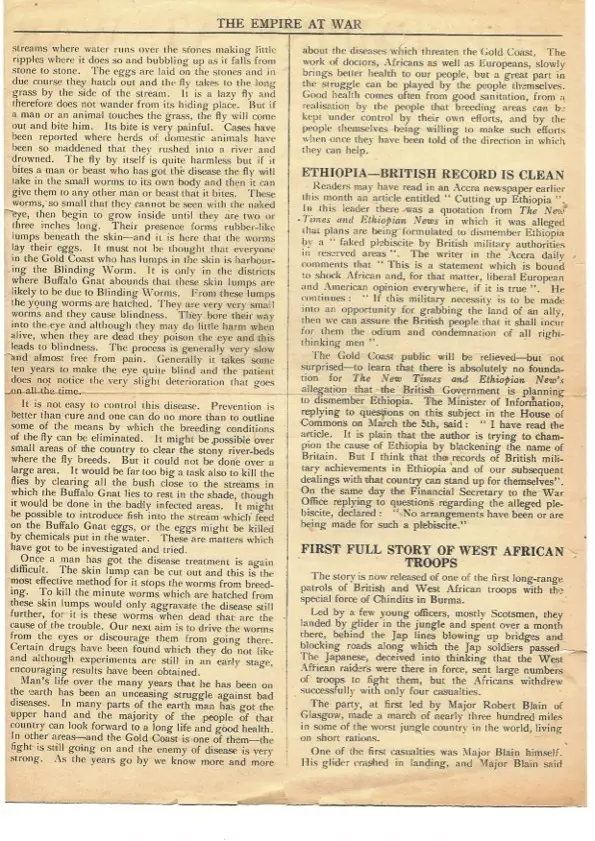
River Blindness is eliminated in parts of Ghana.
This story’s happy ending is that, after decades of coordinated and sustained efforts in Ghana, River Blindness has in many places been declared officially eliminated. This remarkable achievement is due to the government involving local communities in the endemic areas and bringing significant global support from partners like the World Health Organization (WHO), the Carter Center, the African Programme for Onchocerciasis Control (APOC), and USAID, whose technical and financial support was crucial in the journey to disease eradication.
As Harold Ridley had foreseen, the war against the disease would be long-term, with battles fought on many fronts. It began in Ghana in the 1970s with the Onchocerciasis Control Programme (OCP) and continued with APOC. In the early phase, there was a Vector Control programme where the rivers were sprayed with larvicides to reduce blackfly populations, the vector of River Blindness transmission, the Buffalo Gnats, as Ridley named them, which breed in fast-flowing rivers. The effort then was to control the disease, but later, actions intensified as elimination became more than a dream; it became an achievable goal. Ghana established robust surveillance systems to monitor River Blindness and effectively target interventions. Skin snip tests and serological tests were used to assess the presence of the parasite and the level of antibodies in human populations.
Perhaps the most essential key in the elimination programme—and Ridley foresaw this, too—was giving patients a drug against the disease. Ghana undertook a programme of mass administration of the drug Ivermectin, distributed free of charge in endemic areas through the innovative Mectizan Donation Programme initiative. A Community-Directed Treatment with Ivermectin (CDTI) approach allowed trained community members to administer the drug.
Finally, the country underwent a thorough verification by WHO to confirm that the transmission of the disease had been interrupted and that no new cases were occurring. That WHO-verified declaration of elimination means there no longer needs to be mass Ivermectin administration in Funsi and other formerly endemic areas for River Blindness. Surveillance continues - to prevent reintroduction - but this is still a magnificent achievement, and Ridley’s small part in this story should not be overlooked. His intrepid search for the disease in the 1940s should today gain as much public recognition as his invention of the IOL.
Spitting snakes
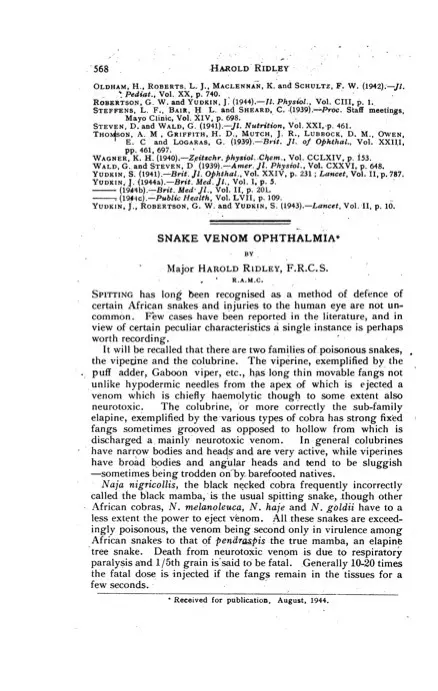
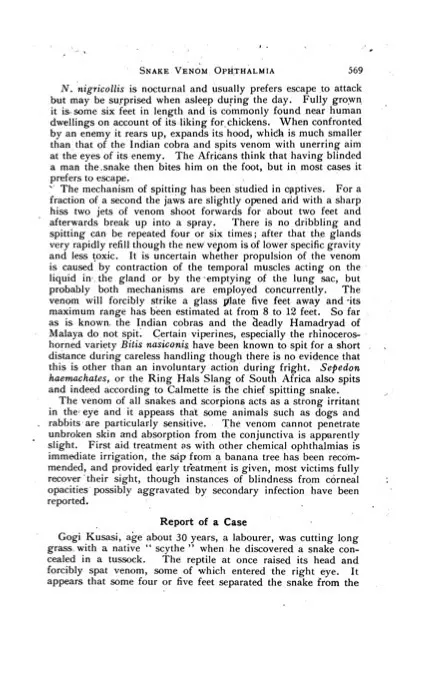
Also in 1944, Harold Ridley published a report in the British Journal of Ophthalmology - with a case report of eye injury from a Black-necked spitting cobra (Naja nigricollis). A 30-year-old labourer named Gogi Kumasi had been cutting grass when a snake forcibly spat venom toward his right eye from a four or five-foot distance.
(Note. The Black-necked spitting cobra (Naja nigricollis) is found chiefly in sub-Saharan Africa. When irritated or threatened, the cobras may eject streams or a spray of venom a distance of 1.2 metres (4 ft) to 2.4 metres (8 ft). These snakes’ fangs are adapted for spitting venom; inside the fangs, the channel makes a 90° bend to the lower front of the fang. Snakes may spit repeatedly and still be able to deliver a fatal bite. It is a defensive reaction only, where the snake aims for the eyes of a perceived threat. Usually, if the venom is washed away immediately with plenty of water, no serious symptoms persist. When left untreated, blindness can become permanent - a blindness caused by severe corneal and conjunctival inflammation.)
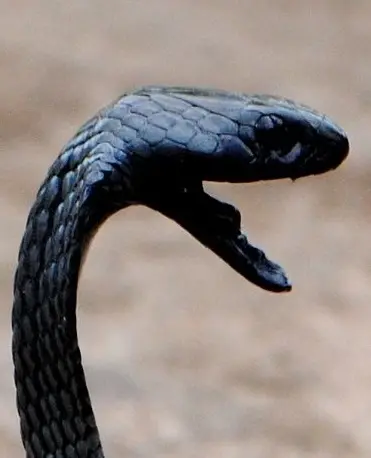
Ridley treated Mr. Kumasi and followed his case until the eye had fully recovered after about a week. His paper discusses the therapeutic uses of snake venom, and he conjectured that in the future, a diluted venom or a constituent of venom might be used as an anaesthetic in some cases of ophthalmic surgery.
The case report’s first page of 5.
and page 2 of 5.
Reference.
Ridley H. SNAKE VENOM OPHTHALMIA. Br J Ophthalmol. 1944 Nov;28(11):568-72. doi: 10.1136/bjo.28.11.568. PMID: 18170065; PMCID: PMC510436.
 A Novice in Tropical Ophthalmology