
EDOF IOLs in monochromatic and polychromatic light
 Contributed by Dr Yumi Lee.
Heidelberg 20 January 2020. The use of monochromatic light in the assessment of intraocular lenses (IOLs) has been criticized in the past for not representing the real-world situation. In our in-vitro study, we aimed to measure and compare the image quality of three extended-depth-of-focus (EDOF) IOL models in monochromatic and polychromatic light and this is reported in the January edition of the Journal for Cataract and Refractive Surgery
Assessment of the image quality of extended depth-of-focus intraocular lens models in polychromatic light. Yumi Lee, MD, Grzegorz Łabuz, PhD, Hyeck-Soo Son, MD, Timur M. Yildirim, MD, Ramin Khoramnia, MD, FEBO, Gerd U. Auffarth, MD, PhD Journal of Cataract and Refractive Surgery: January 2020 - Volume 46 - Issue 1 - p 108–115doi: 10.1097/j.jcrs.0000000000000037
Download PDF: Assessment of the image quality of extended depth-of-focus intraocular lens models in polychromatic light
What we studied
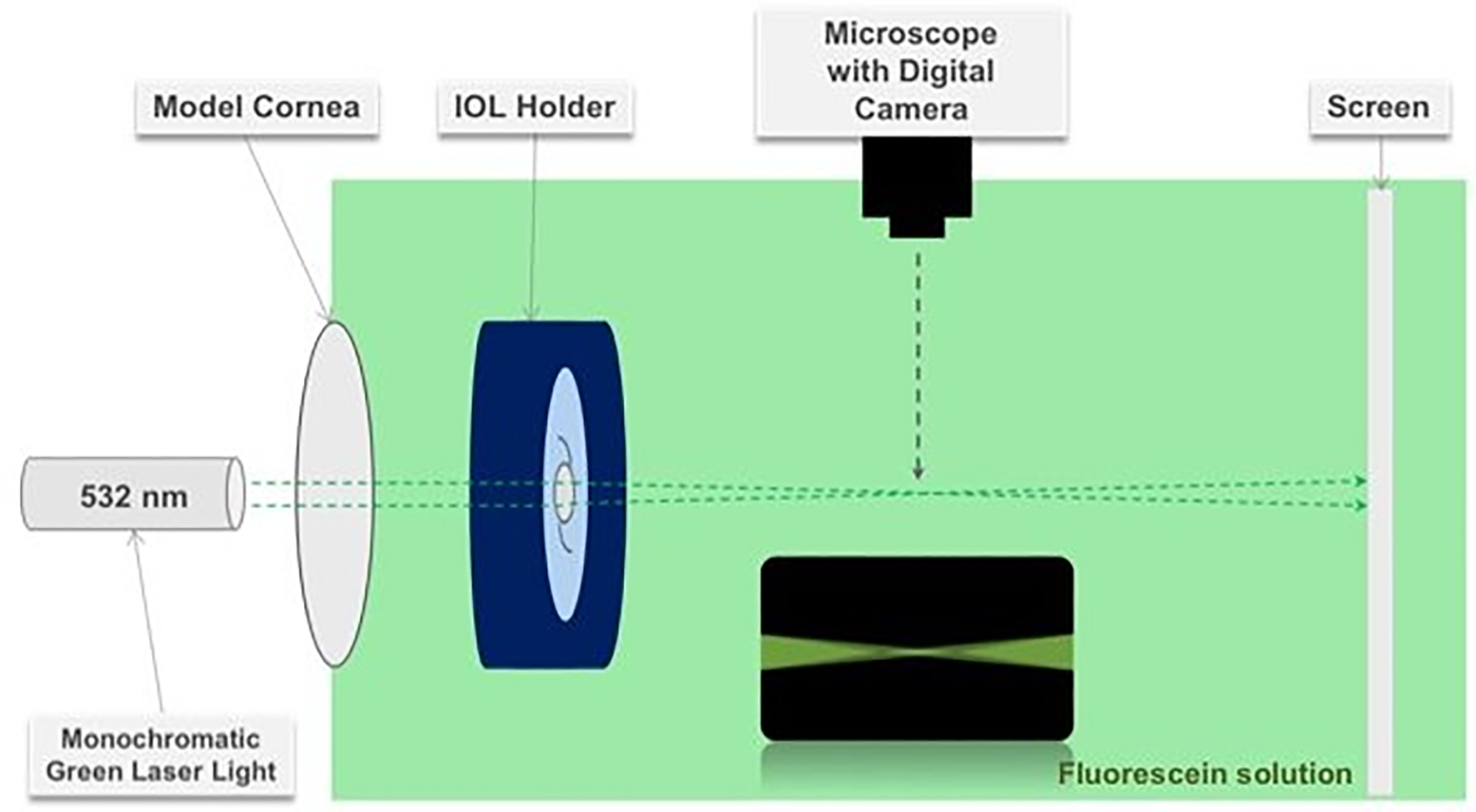
We used an optical metrology instrument to study image quality metrics of diffractive IOLs with chromatic aberration correction (J&J Symfony and Zeiss AT Lara) and a refractive lens (SIFI Mini Well). The modulation transfer function (MTF) was measured in green and polychromatic light at a 2.0 mm, 3.0 mm, and a 4.0 mm aperture. The EDOF IOL’s tolerance to defocus was tested against a monofocal lens.
Our results
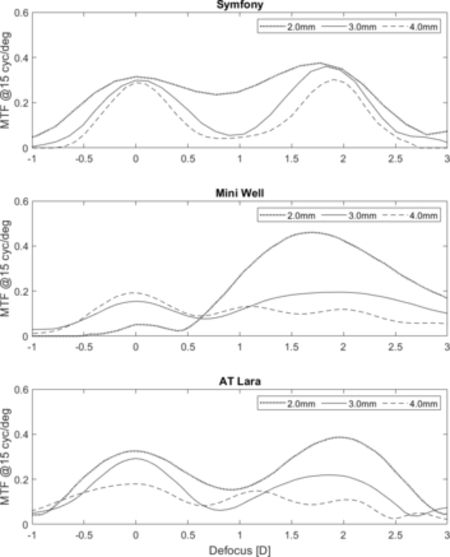
We found that the mean MTF of the EDOF IOL at a far distance was decreased in polychromatic compared with monochromatic light. The largest effect was found in the refractive lens; however, at an intermediate distance, only small differences occurred.
In their tolerance to defocus, the EDOF IOLs were superior to the monofocal IOL. The diffractive IOL had higher MTFs than that of the refractive IOL at 2 primary foci, the refractive IOL’s optical quality varied less with defocus at 3.0 mm. The refractive lens was the most susceptible to changes in aperture size.
Conclusion
The diffractive EDOF IOL was more resistant to chromatic effects than the refractive IOL. The EDOF IOLs provided an extended through-focus performance compared with the monofocal IOL, but differences in optical design, particularly pupil dependency, should be considered when refining IOL selection for patients.
What was known before
- Extended depth-of-focus (EDOF) IOL models create a continuous range of vision for pseudophakes, but the visual quality the lenses provide may differ, given the variety of designs and working principles.
What this paper adds
- Although all the EDOF IOLs that we studied proved more tolerant to defocus than a standard monofocal IOL, the key differences lie in their management of chromatic and spherical aberration effects, pupil dependency, and the optical quality at discrete visual points,
- These differences may be taken into account to optimize postoperative visual outcomes.
 Reasons for explanting IOLs