
Heidelberg, 30 January 2026 We are pleased to see our paper in print in this month’s Ophthalmology and Therapy journal, this was also e-published ahead of print in November 2025.
Chychko L, Augustin VA, Son HS, Schickhardt SK, Daniel V, Khoramnia R, Auffarth GU. Changes of Aqueous Humor Cytokine and Chemokine Profiles in Femtosecond Laser-Assisted Cataract Surgery in Comparison to Conventional Phacoemulsification. Ophthalmol Ther. 2026 Jan;15(1):339-350. doi: 10.1007/s40123-025-01272-2. Epub 2025 Nov 18. PMID: 41252069; PMCID: PMC12882892.
What did we do?
We investigated early postoperative anterior chamber (AC) inflammation in the period after femtosecond laser-assisted cataract surgery and compared that to conventional phacoemulsification by quantifying inflammatory and oxidative stress mediators in the aqueous humor and correlating our results with clinical data.
What were our methods?
We made a prospective study – enrolling 80 cataract patients from the Eye Department of the University Hospital of Heidleberg. We took Aqueous humor samples from the AC after femtosecond laser pretreatment in the FLACS group (40 patients) and took smaples at the beginning of standard cataract surgery before the primary incision was created in the CPS group (40 patients, control group). Working in cooperation with the Institute of Immunology of the University of Heidelberg, we used multiplex immunoassays to measure the mediators of postoperative inflammation, including TNF-α, VEGF, IL-2, IL-1 β, IL-4, IL-5, IL-6, IL-8, IL-10, IL-12, GM-CSF, IFN-γ, CXCL5/ENA-78, FGF-basic, G-CSF, IL-1-α, IL-1-ra, IL-17, CCL2/MCP-1, CCL3/MIP-1a, CCL4/MIP-1b, TPO, TGF-β-1, TGF-β-2 and TGF-β-3.
The differences between both groups were analyzed using Mann–Whitney U test.
What results did we get?
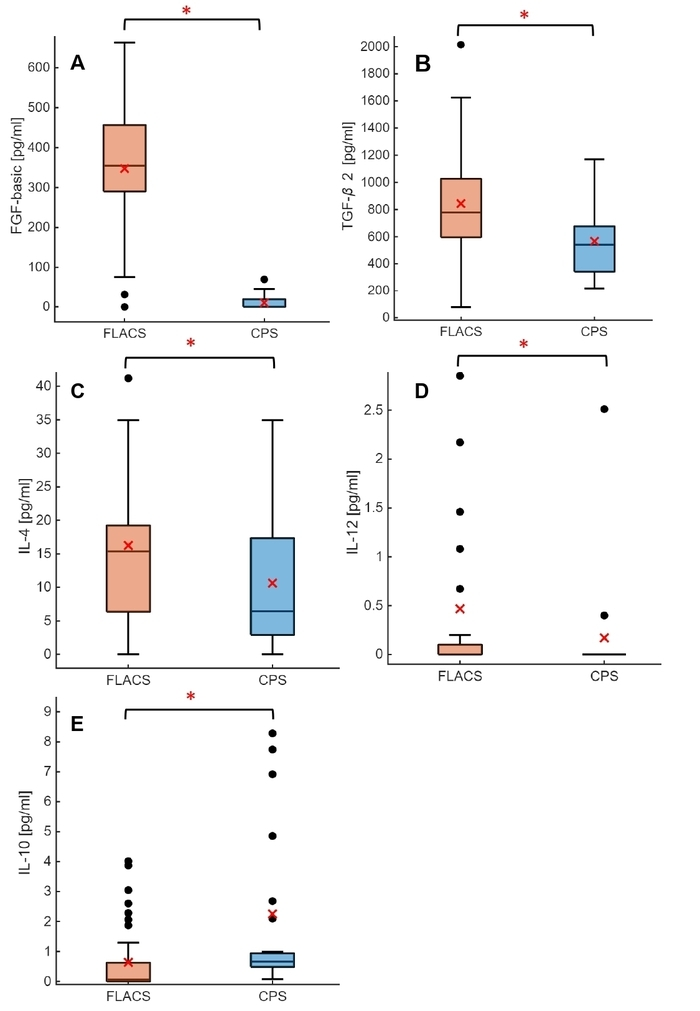
Figure 1: Boxplots showing inflammatory cytokine concentrations. A Cytokine concentrations of basic fibroblast growth factor (FGF-basic). B Transforming growth factor beta 2 (TGF- β 2). CInterleukin (IL)-4. D IL-12. E IL-10 in aqueous humor were measured using a multiplex immunoassay and compared between the FLACS and CPS groups. indicates statistical significance (p < 0.05). FLACS group patients who underwent femtosecond laser-assisted cataract surgery; CPS group* patients who underwent conventional phacoemulsification
In the FLACS group, there were significantly higher concentrations detected of IL (interleukin)-4, FGF-basic (fibroblast growth factor) and TGF-ß2 (Transforming growth factor-beta 2) compared to the CPS group.
Conversely, IL-10 levels were significantly higher in the CPS group than in the FLACS group.
What did we learn?
Femtosecond laser-assisted cataract surgery induces both proinflammatory and profibrotic cytokine responses. The surgery triggers a distinct cytokine and growth factor profile in the aqueous humor, including elevated levels of IL-4, IL-12, FGF-basic, and TGF-β2 and a reduction in anti-inflammatory IL-10, indicating a shift toward proinflammatory and fibrotic signalling. These molecular changes may underlie immune activation and tissue remodelling that is not apparent in clinical examination. Femtosecond laser pretreatment may influence immune activation and repair processes more profoundly than previously recognized.
Concluding comment
Prof. Dr med Gerd U Auffarth: “Until recently perhaps we have overlooked the diagnostic potential of aqueous humor. But that is now changing and the results of this study point to the need for further studies to evaluate the long-term clinical relevance of these changes. We must continue with this line of research.”
 2025: 57+ publications